Environmental impact assessments of oil fields are standard practice, given the risks involved in oil exploration and production. From land degradation to water contamination, the ecological footprint of an oil field can be substantial.
As companies work to balance resource extraction with environmental responsibility, they need advanced monitoring to track and reduce these impacts. Traditional assessments rely on field surveys and manual inspections, which are costly and slow. Satellite technology is changing how operators monitor, assess, and shrink their environmental footprint.
Understanding the Environmental Impact of Oil Fields
The impact of oil field operations reaches well beyond the extraction site, affecting surrounding ecosystems and communities. The primary concerns include:
- Deforestation and land disruption — clearing land for drilling can cause habitat loss, soil erosion, and desertification.
- Water pollution — spills, produced-water discharge, and drilling waste can contaminate rivers, lakes, and groundwater.
- Air emissions — gas flaring, methane leaks, and volatile organic compounds contribute to air pollution and climate change.
- Biodiversity loss — disrupted habitats affect both local and migratory species.
- Waste management challenges — improper disposal of drilling byproducts can cause long-term damage.
With timely satellite insights, companies can take proactive steps to reduce these risks while staying compliant with environmental regulations.
How Satellites Are Transforming Environmental Assessments of Oil Fields
Modern satellites carry high-resolution imaging and specialized sensors that enable an unprecedented level of environmental monitoring. With them, operators can detect and respond to ecological threats faster than ever.
Monitoring Land Use and Vegetation Change
Satellite imagery reveals detailed land-use patterns, helping operators track vegetation loss, deforestation, and landscape disturbance from extraction. Multispectral and hyperspectral imaging let companies assess ecosystem health and begin restoring degraded areas.
Detecting Oil Spills and Water Contamination
Oil spills can be catastrophic for water bodies and marine life. Satellite-based SAR detects oil slicks early, enabling rapid response and containment. Infrared sensors can also identify changes in water composition, helping prevent long-term contamination.
Assessing Air Quality and Emissions
Monitoring emissions is essential to reducing impact. Satellites with infrared and thermal sensors can detect methane leaks, track flaring, and measure greenhouse gas concentrations in real time — giving companies the data to cut emissions and meet regulations.
Protecting Wildlife and Sensitive Ecosystems
Satellite data helps monitor changes in animal habitats so operators can minimize disruption. By tracking migratory patterns and deforestation, they can design drilling practices that reduce harm to biodiversity.
Predicting and Preventing Soil Degradation
Drilling can erode soil and reduce land productivity. Satellites track changes in soil composition, moisture, and topography, supporting targeted land restoration and better waste management.
Example: Monitoring the Environmental Impact of Oil Fields
The challenge: Region X faces ongoing environmental degradation from oil spills, illegal bunkering, gas flaring, and deforestation — in one of the world’s most oil-rich but ecologically vulnerable regions.
The solution: A multinational energy company operating several onshore and offshore fields partnered with a geospatial analytics firm to implement continuous environmental monitoring, using Earth observation data sourced through the SkyWatch platform.
Data Providers Used
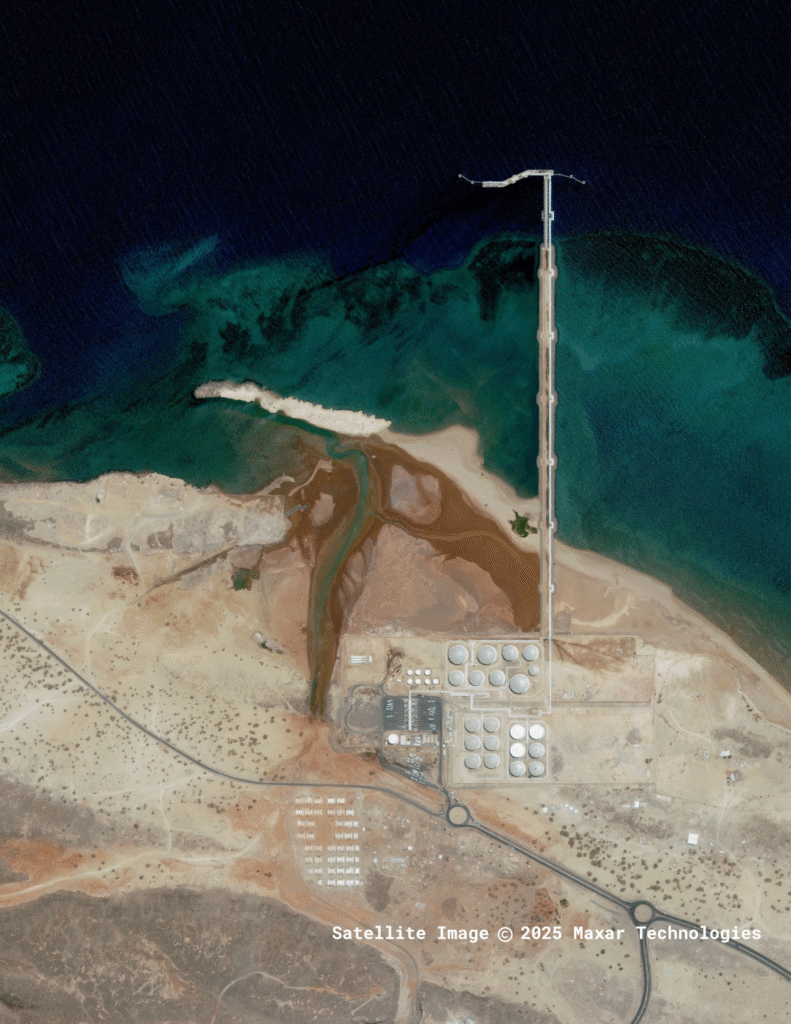
- Vantor (formerly Maxar) — very high-resolution (VHR) imagery at 30 cm for oil spill detection and land-use mapping
- Capella Space — SAR data for all-weather oil spill and surface-disturbance detection
- Planet — daily-revisit optical imagery at 3 m for vegetation monitoring and illegal-clearing detection
Implementation Highlights
- Oil spill detection. SAR data from Capella Space can detect surface anomalies consistent with oil slicks near offshore rigs and along inland waterways. Paired with Maxar VHR imagery, the operator can confirm pipeline breaches and direct cleanup crews faster than traditional inspection reports allow.
- Vegetation and land-cover change. Using PlanetScope’s daily imagery and Sentinel-2, the firm can monitor seasonal vegetation health around drilling pads and pipeline corridors. NDVI analysis can flag early-stage deforestation, allowing intervention before significant habitat loss.
- Biodiversity risk mitigation. By combining Maxar and Planet imagery with species-distribution models, the company can identify critical wetland bird habitats near exploration zones — then adjust drilling schedules and access routes to minimize disruption during nesting seasons.
- Regulatory compliance and reporting. With AI-driven change detection enabled, automated weekly reports give both the national oil spill response agency (NOSDRA) and internal ESG teams an easy way to track this data — strengthening transparency and helping avoid fines.
Outcomes
- Faster response — time to detect and respond to environmental incidents dropped from weeks to 48 hours.
- Lower inspection costs — satellite-based monitoring cut inspection costs by 60%.
- Improved ESG ratings — demonstrable environmental stewardship helped secure renewed licenses.
- Stronger community relations — impact reports improved relationships with local stakeholders.
A Future-Forward Approach
Satellite-based environmental monitoring is reshaping how oil and gas companies approach sustainability. As technology advances, AI and machine learning will further sharpen satellite data analysis — enabling predictive monitoring and more effective mitigation.
By adopting satellite-driven assessments, oil companies can shrink their ecological footprint and build a more responsible, resilient energy sector. As the industry shifts toward greater sustainability, these innovations will help ensure that energy production and environmental stewardship go hand in hand.

HUB
for large projects that need consistent data collection, storage, easy sharing, and team management.

ArcGIS Pro Add-In or Content Store
for specialists in Esri's ArcGIS Pro or Online who want to buy imagery in the Esri ecosystem.

EXPLORE
for smaller projects or teams testing satellite imagery: no contracts, pay-as-you-use data.